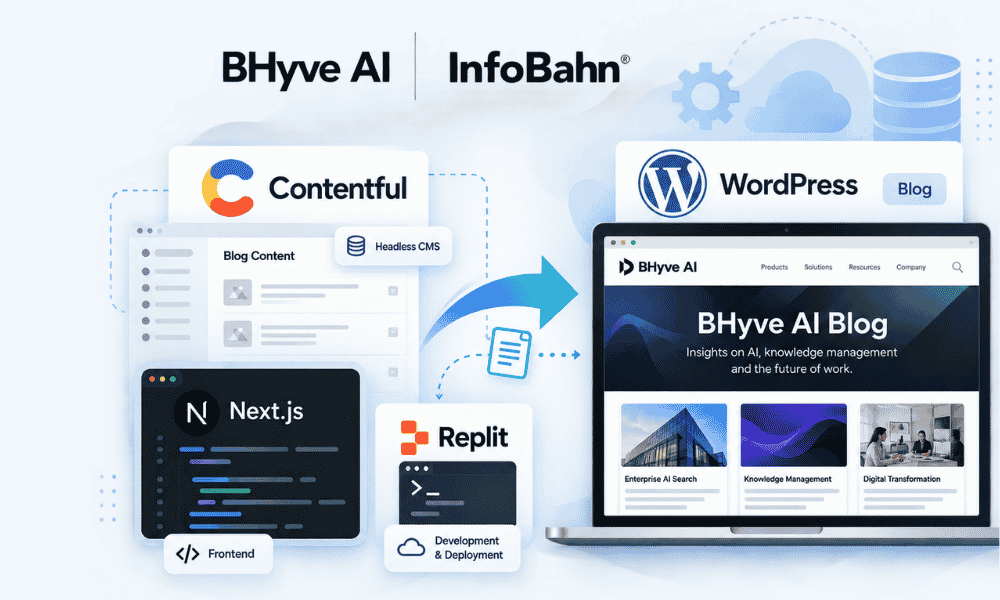
How InfoBahn Rebuilt BHyve AI’s Blog – Contentful to WordPress Case Study
BHyve AI is an enterprise knowledge management company helping organizations capture, organize, and make better use of their institutional knowledge.
Its solutions serve industries including manufacturing, accounting and energy, supporting functions such as service desks, quality management, safety, employee training and knowledge discovery.
BHyve AI works with organizations including GMR, Tata Play, KKC and JSL. It is the ideal choice for companies with 250 – 10000 employees.
Its product ecosystem consists of three solutions:
- BHyve Ask: An AI-powered enterprise search assistant that helps employees find answers across organizational knowledge.
- BHyve Wiki: A document and knowledge management system for organizing institutional knowledge.
- BHyve Grow: An enterprise learning management system for employee training and development.
As BHyve AI’s content strategy evolved, its blog needed to do more than publish articles. It needed to attract organic traffic, support internal linking, generate leads and contribute to the company’s broader digital marketing strategy.
InfoBahn was tasked with rebuilding the blog without disrupting the existing website.
The Challenge: A Headless CMS That Restricted SEO & GEO efforts
BHyve AI’s existing blog used Contentful, a headless CMS.
While the platform served its original purpose, restrictions in the content editor were limiting our ability to control HTML.
One particular frustration was same-page hyperlinking. We wanted to create anchor links that could take readers directly to specific sections within an article.
We also needed greater control over HTML structure, internal linking and lead-generation elements.
WordPress offered the flexibility we needed, along with a mature ecosystem of SEO, analytics and marketing plugins.
But we didn’t want to rebuild the entire BHyve AI website just to replace its blog.
The Solution: WordPress on Another Server
We decided to host WordPress on a separate server and use a reverse proxy to serve the blog through the existing BHyve AI domain.
The main website would continue operating on its original infrastructure, while requests to bhyve.io/blogs/ would be routed to the WordPress server.
For visitors, everything would still appear under bhyve.io.
Behind the scenes, however, two independent systems would be serving different parts of the website.
This allowed us to introduce WordPress without migrating the entire website or moving the blog to a separate subdomain.
Migrating Contentful to WordPress Using Replit
Moving the existing content presented its own challenges.
Rather than manually copying articles, we used Replit to build a custom migration application.
The application connected to Contentful, retrieved the existing content and transferred it into WordPress, one post at a time.
The actual migration involved more than moving article text.
Two particularly challenging elements were mapping the featured images and preserving the original publication dates.
Featured images needed to be correctly associated with their corresponding WordPress posts. Publication dates also needed to be retained so that older articles didn’t suddenly appear as newly published content.
We used Replit to do the heavy lifting, developing and refining the migration application to handle these requirements.
This approach gave us a repeatable process and avoided manually recreating the entire blog.
BHyve AI is ISO 27001 and SOC 2 Type II compliant, and adheres to DPDP, GDPR, and HIPAA requirements. This meant that when we moved the blog, we also had to take these compliance and data security requirements into account throughout the migration.
Building and Testing Before Going Live
We didn’t migrate directly onto the live blog URL.
Instead, we built the entire WordPress blog on a separate URL.
This gave us an environment where we could migrate the content, configure WordPress, recreate the design and test the new publishing experience without affecting the existing blog.
Once the content migration was complete, we reviewed the website, made the necessary adjustments and submitted it for approval.
Only after everything was ready and approved did we switch the actual blog URL to the new WordPress installation.
The transition was completed with zero downtime.
The existing blog remained available while the replacement was being prepared, allowing us to make the switch without interrupting visitors.
Recreating the BHyve AI Experience
One interesting challenge was making WordPress look like the existing BHyve AI website.
We recreated the header and footer, matching the navigation, typography, spacing and overall design.
The result is remarkably close, although not an exact replica. A designer examining both versions closely might notice subtle differences. Most visitors probably won’t.
There is, however, a maintenance trade-off.
The header and footer now exist in two places. Changes to the main website’s navigation or footer must also be replicated in WordPress.
It’s an additional responsibility, but one we accepted because the benefits of WordPress outweighed the inconvenience.
Better SEO, GEO and AEO Capabilities
The migration gave us considerably more control over how content is structured, optimized and measured.
With WordPress and Yoast SEO, we can now manage:
- SEO titles, meta descriptions and URL slugs.
- Internal linking and same-page anchor links.
- HTML structure, headings and content organization.
- Canonical URLs, XML sitemaps and redirects.
- Lead-generation forms and calls to action.
Another significant advantage is access to analytics through WordPress plugins.
We can introduce tools that help us understand content performance, visitor behaviour and engagement without developing every reporting capability from scratch.
This supports three important areas of our content strategy.
SEO (Search Engine Optimization): Better control over technical SEO, internal linking and content structure helps us optimize for traditional search engines.
GEO (Generative Engine Optimization): Greater flexibility in structuring content helps us make information clearer and more accessible to AI-powered discovery systems.
AEO (Answer Engine Optimization): We can organize articles around specific questions, provide concise answers and use appropriate HTML structures to improve content clarity.
WordPress doesn’t automatically guarantee better search rankings or AI visibility. What it gives us is the flexibility and tooling to implement, measure and continuously improve these strategies.
The Result: A More Flexible Content Engine
The BHyve AI blog now runs on WordPress, hosted on a separate server but served seamlessly through bhyve.io.
We migrated the content using a custom application built with Replit, preserved important publishing information, recreated the website’s visual experience and completed the transition with zero downtime.
We also gained a more capable publishing environment for SEO, GEO, AEO, analytics and lead generation.
The architecture introduces some additional maintenance, particularly around keeping the header and footer consistent across two systems.
But the benefits are substantial.
For InfoBahn, this project demonstrated an important principle: you don’t always need to rebuild an entire website to solve a content management problem.
Sometimes, the better approach is to introduce the right technology where it is needed, connect it intelligently to the existing infrastructure and preserve the experience for visitors.
That’s exactly what we did for BHyve AI.
Article edited by Ibrahim Rumani.

